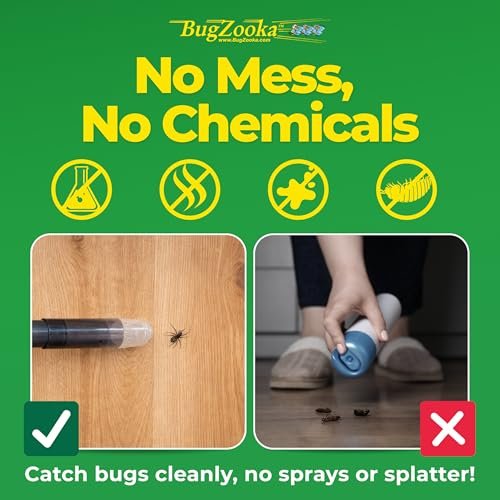
BugZooka WB100 — No Batteries, No Chemicals, No Mess

The BugZooka WB100 uses a spring-loaded bellows — not a motor, not batteries — to fire a single burst of suction that pulls spiders, stink bugs, wasps, and moths into a clear catch tube before they know what happened. No charging. No spray residue. No fan agitating the stink bug before it's secured. At 37¾ inches fully extended, you've got over 3 feet between you and whatever's on the ceiling, and the removable catch tube carries it to the door without opening anything near your face. More than 5,000 buyers have rated this thing, and multiple reviewers describe using the same unit for a decade or more — because there's nothing mechanical to wear out except the nozzle flaps.

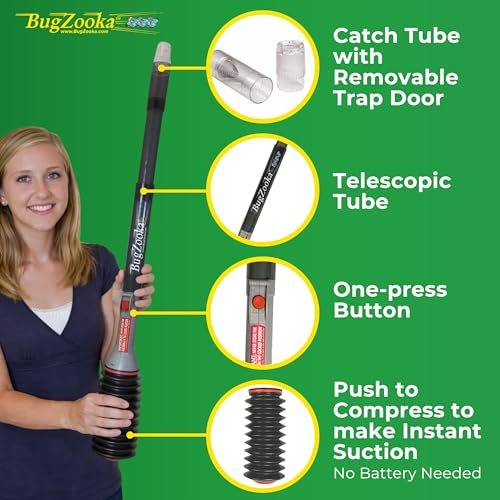
✓ Spring-loaded instant suction✓ Battery-free, always ready✓ 37¾" telescoping nozzle
Check Current Availability on Amazon
BugZooka - Bug Vacuum for Adults - No Batteries or Toxic Chemicals
10x Instant Suction, Zero Batteries Ever 10x Instant Suction, Zero Batteries Ever

The spring-loaded bellows stores negative pressure before you fire — releasing it all at once in a single burst that delivers 10x the instant suction of continuous-motor bug vacuums, with nothing to charge or replace.

Catches Stink Bugs Without Triggering the Odor Catches Stink Bugs Without Triggering the Odor

No fan means no continuous airflow to agitate the bug before capture — one pressure burst pulls the stink bug in cleanly, without triggering the defensive spray that makes motorized vacuums so unpleasant for this job.

37¾ Inches Between You and the Bug 37¾ Inches Between You and the Bug

The telescoping nozzle extends from 32¼ inches to 37¾ inches — enough reach for ceiling bugs without a step stool, and enough distance to stay comfortable with wasps, large wolf spiders, and anything else you'd rather not get close to.

Still Working After 10 Years of Use Still Working After 10 Years of Use

No motor to burn out, no battery to degrade, no charge port to corrode — multiple buyers report using the same WB100 unit for 8, 10, even 12 years, with the nozzle flaps as the only component that shows meaningful wear over time.

BugZooka WB100 Bug Vacuums — All Three Configurations

Every BugZooka in the lineup runs on the same spring-loaded bellows mechanism — the same 10x instant suction, the same fan-free stink bug capture, the same telescoping nozzle. The only difference is how many units ship in the box, which makes the choice simple: one unit to try it, two for a multi-story home, four for whole-home or property coverage.

BugZooka - Bug Vacuum for Adults - No Batteries or Toxic Chemicals

WB100 Bug Vacuum Single Pack

The flagship WB100 in single-unit form — 1.3 pounds, spring-loaded bellows, telescoping nozzle that extends to 37¾ inches, and a removable clear catch tube with snap-close nozzle flaps. At 4.1 stars across more than 5,000 reviews, it's the most-reviewed bug vacuum in its category and the product that put BugZooka on Wirecutter's radar.

The lowest-commitment way to try BugZooka — and with over 5,000 reviews behind it, there's not much uncertainty about whether it works.

See on Amazon
BugZooka WB100 Bug Catcher Vacuum (Twо Расk)

WB100 Bug Vacuum Two Pack

Two full WB100 units in one order — same mechanism, same specs, same telescoping nozzle as the single pack. The 4.3-star rating (slightly higher than the single unit's 4.1) reflects a buyer pool that already knows the product and is satisfied enough to double up. Home Depot reviewers describe the exact pattern this bundle solves: buying a second unit for another floor.

The practical choice for multi-story homes — one unit per floor means you're never carrying it up stairs while a stink bug waits on the ceiling.

See on Amazon
BugZooka WB100 Bug Catcher Vacuum (4-Pack)

WB100 Bug Vacuum Four Pack

Four WB100 units under model number WB100-4PK — enough to cover every floor, the garage, and a storage area without moving a single unit between rooms. Listed in a gray colorway and ranked in the Pest Control Traps category. Same bellows mechanism throughout; the quantity is the only difference from the single and two-pack configurations.

Built for large homes, vacation rental properties, or anyone who wants a BugZooka within arm's reach in every room — no hunting for it when a bug appears at 10pm.

See on Amazon

What BugZooka Does Well — and Where It Struggles

The WB100 catches stationary bugs on flat surfaces with a high success rate — spiders on walls, stink bugs on windows, ladybugs on baseboards, moths resting on ceilings. Position the nozzle within half an inch, press the trigger, and the bug is in the tube before it can react. That's the scenario the product was built for, and it delivers consistently.

Flying insects are a different story.

A housefly at rest is catchable — if you approach from behind, slowly, without triggering the vibration-sensitive hairs on its legs. A housefly in the air is nearly impossible. The bellows fires a single instant burst, not a continuous pull, so there's no sustained draw to intercept a moving target. Buyers who expect a mid-air capture tool will be disappointed. That's not a design flaw — it's just physics. The product trades continuous suction for a much more powerful single burst, and that tradeoff works brilliantly for the bugs most people are actually trying to catch at home.

Bug-by-Bug Capture Guide

Here's an honest breakdown of what to expect across common household insects:

  • Stink bugs (wall, window, ceiling): Excellent. This is BugZooka's strongest use case. No fan agitation means no defensive odor — the bug is in the tube before it knows anything happened. Users across mid-Atlantic Reddit threads and Amazon Q&A confirm this consistently.
  • House spiders and wolf spiders: Very reliable on walls and floors. Approach center-nozzle over the body, not the legs. Daddy long-legs and other fragile species may lose a leg if the angle is off, but survive capture intact otherwise.
  • Wasps and bees (resting): Works well from distance — the telescoping nozzle keeps you 37¾ inches back, which matters here. Don't attempt mid-flight.
  • Ladybugs and moths: Easy catches. Both tend to rest for extended periods, which gives you time to arm the bellows and approach carefully.
  • Houseflies at rest: Possible but technique-dependent. Approach from behind. Any vibration from footsteps or the nozzle shadow can launch them before you fire.
  • Large cockroaches or waterbugs: Hit or miss — oversized insects may not fit cleanly through the nozzle opening, or may not be fully secured in the catch tube.
  • Fast-flying insects mid-air: Not the right tool. Gnats, fruit flies in motion, mosquitoes in flight — the burst system isn't designed for aerial interception.

The Most Common Failure Mode

The single biggest source of "weak suction" complaints isn't a product defect — it's a skipped step. Most frustrated users approached the bug first and pressed the trigger without arming the bellows. An unarmed bellows has no stored negative pressure to release. The result feels like nothing happened, because nothing did.

Single BugZooka bug vacuum photographed diagonally showing full length with bellows grip and clear catch tube

Arm first. Always. Compress the bellows until it locks — you'll hear and feel the click — then walk toward the bug.

Who BugZooka Is Not Right For

Worth saying plainly: if your primary pest problem is flying insects in motion, this isn't the tool. A fly tape, a light trap, or a swatter will serve you better for that specific job. BugZooka also requires two functional hands to arm — one to hold the unit, one to compress the bellows, or the bellows pressed against the hip. For users with significant hand arthritis or grip limitations, the arming step can be genuinely difficult. The hip-press workaround helps, but it's worth knowing before purchase.

For everything else — the spider on the bathroom ceiling at midnight, the stink bug parade every October, the wasp that got in through a window — it's hard to find a simpler solution.

Why Stink Bug Season Demands a Fan-Free Tool

The Brown Marmorated Stink Bug — BMSB — invades homes across the mid-Atlantic and Appalachian regions every fall, typically September through November, seeking warmth before temperatures drop. A single home can harbor dozens, sometimes hundreds, appearing on walls, windows, and ceilings without much warning. The problem isn't just their numbers. It's what happens when you try to remove them the wrong way.

Squish one and you know immediately. The odor — often described as a cross between cilantro and industrial solvent — lingers for hours. But squishing isn't the only trigger. Any sustained airflow agitates a stink bug before it's secured, and that agitation activates the same defensive response. Running a shop vac or a battery-powered bug vacuum near a stink bug often means the bug is spraying while it's still being drawn toward the nozzle — before it's contained, while the airflow is still moving past it.

Why Motorized Vacuums Make the Smell Worse

A continuous-fan vacuum — battery-powered or plug-in — pulls air through a spinning motor at a steady rate. When you point it at a stink bug, the bug experiences a sustained wind before capture. That sustained disturbance is exactly what the insect's biology is designed to respond to. By the time the bug reaches the catch tube, the odor-producing glands have already fired.

BugZooka has no fan and no motor. When you press the trigger, the stored bellows pressure releases in a single instant burst — roughly 3 milliseconds of intense negative pressure that pulls the bug into the catch tube faster than the insect's nervous system can process and respond to a threat. There's no sustained airflow warning. The bug doesn't get the signal to spray.

Collage of women using BugZooka indoors and outdoors in kitchen, porch, garden, and ceiling corners

This isn't marketing language. It's the mechanical reason the product works differently for stink bugs specifically — and why the r/DIY commenter who accidentally flushed a BugZooka full of stink bugs down the toilet reported no odor problem despite catching them successfully.

Practical Stink Bug Technique for Invasive Season

Mid-Atlantic homeowners dealing with BMSB season should know a few things that make the tool work better at peak volume:

  • Arm the bellows before entering a room with stink bugs. Don't compress it two feet from the bug — the bellows compression sound can be enough to trigger movement.
  • Approach window-resting bugs from below or the side, not straight-on. Head-on approaches cast a shadow that prompts the bug to walk away before you can fire.
  • The clear catch tube holds multiple bugs between releases — you don't need to go outside after every single catch. Walk the perimeter of a room, collect several, then release outside all at once.
  • Release outdoors well away from the house's entry points. Stink bugs locate warmth through scent trails and can re-enter through the same gaps they came in from.

The DIY Stink Bug Trap Alternative

The foil roasting pan trap — soapy water in an aluminum pan with a light above it in a darkened room — is the method most frequently cited by Penn State Extension researchers as an effective passive capture method. It works, but it's a kill trap and requires setup, a darkened space, and disposal. BugZooka is the active-removal tool for bugs already inside the living space, caught during the day without any setup. Both have a role during heavy invasion periods; they're solving different moments of the same problem.

The short version: if you live in Virginia, Maryland, Pennsylvania, West Virginia, Ohio, or any of the other 47 states where BMSB has now established populations, a BugZooka during stink bug season isn't a novelty purchase. It's the practical solution that doesn't trigger the smell you're trying to avoid.

How to Get a Clean Catch Every Time

The arming sequence is the most important thing to understand about the WB100 — and the step most first-time users skip. Almost every "the suction didn't work" complaint traces back to firing an unarmed unit. Two steps, done in the right order, gets you a reliable catch.

Step 1 — Arm the Bellows Before You Approach

Find the bellows — the accordion-shaped compression chamber at the rear of the unit. Press it against your hip or thigh (or use both hands if grip strength allows) until it compresses and locks. You'll feel the resistance give way when it seats. That stored compression is the entire source of suction. Without it, pressing the trigger does nothing useful.

Do this before you enter the room where the bug is, or at least before you get within 6 feet of it. The compression sound is brief, but bugs on smooth surfaces can detect vibration, and some will move if they sense disturbance nearby.

Step 2 — Approach Angle Matters More Than Speed

The nozzle tip needs to be within about half an inch of the bug when you fire. That's the effective capture distance — not 2 inches, not 6 inches. Half an inch. The burst is powerful, but it's concentrated at the nozzle opening, and the effective range drops off sharply beyond that point.

Approach from below or from the side when possible. A head-on approach casts a shadow directly onto the bug and will prompt movement from alert species. Coming from slightly below and in front — the way you'd scoop something up — works better for wall and window bugs. For ceiling bugs, come up at an angle rather than pointing straight up at the insect.

Person holding extended BugZooka upward toward ceiling corner demonstrating telescopic reach for hard-to-access areas

Step 3 — Fire and Confirm

Press the trigger cleanly. Don't jab — a smooth press gives the bellows full release. The bug should be in the tube immediately. The two spring-loaded flaps at the nozzle tip snap closed behind it to prevent escape. You'll usually see the bug in the clear catch tube before you've fully processed that you pressed the button.

If you miss: don't press again immediately. The bellows needs to be re-armed before firing again — pressing an unarmed trigger a second time won't improve results. Step back, re-arm against your hip, re-approach.

Carrying and Releasing

The catch tube is removable — twist it off the nozzle body and carry it to an exit without opening it near your face. Once outside, point it away from yourself and remove the tube end to release. For stink bugs, walk at least 20 feet from the building before releasing; for spiders, any outdoor surface away from entry points works fine.

The Hip-Press Technique for Easier Arming

Users who find the bellows hard to compress by hand — whether from grip fatigue during a heavy stink bug season or limited hand strength — describe the hip-press as a reliable workaround. Hold the unit against your hip or upper thigh, bellows facing your body, and press your body weight into it rather than using hand strength. The bellows compresses fully with minimal grip force. This technique is mentioned in the product instructions and confirmed by multiple reviewers as the way to make arming easier during high-volume use periods.

One unit, one catch, one re-arm. That's the rhythm. Users who internalize it get clean captures on the first attempt; users who rush the arming step or fire from too far away get frustrated. The technique is straightforward — it just needs to become automatic.

What Owners Say After Years of Real Use

"We get stink bugs every fall — dozens of them on the walls and windows. I tried a shop vac once and immediately regretted it. The BugZooka catches them without any smell at all. I've used the same unit for going on five years. The only trick is remembering to arm it first — took me a couple of misses to figure that out."
— Karen M., homeowner in central Pennsylvania, mid-Atlantic stink bug region
"I'm genuinely terrified of spiders and this has changed my life a little. I can catch a wolf spider on the wall from a comfortable distance, carry the tube to the back door, and release it in the yard without ever seeing it outside of the clear tube. I bought a second one so I have one upstairs and one downstairs. The only downside is if you miss, you have to re-arm it before trying again."
— Diane R., arachnophobe, Pacific Northwest
"We homeschool and this has become part of our nature curriculum. The kids catch moths and beetles with it, look at them through the tube, then release them outside. It's held up to a lot of use — my daughter has caught and released probably 200 bugs with it over the past two years. I'll note that very delicate insects like certain moths can get a bit roughed up by the suction, so we're selective about what we try to catch with it."
— Teresa B., homeschooling parent, Ohio
"Bought the two-pack after using one unit for about a year. Having one on each floor means I actually use it instead of just going to get it. The slight rating difference between the single and two-pack makes sense — by the time you're buying two, you already know it works. The nozzle flaps on my original unit have started to feel a little loose after heavy use, but they still close well enough to hold a bug."
— Mark S., multi-story homeowner, mid-Atlantic
"Got the four-pack for a rental property we manage. Guests love it and it's reduced the 'there's a bug in the cabin' complaints by a lot. They're simple enough that guests figure them out without instructions. No batteries to go dead, no chemicals to worry about around kids. The gray color is a slight variation from the black single-pack, but mechanically they're identical."
— Paul V., vacation rental property manager
"Wirecutter recommended it and I was skeptical — seemed too simple. But it really does catch ceiling bugs better than anything else I've tried. The extension is long enough that I don't need a step stool for most ceilings. My one honest note: flies are harder. Slow-moving flies at rest are catchable but fast-moving ones just aren't, so I keep a fly swatter for that. For spiders, stink bugs, and moths, this is the only thing I use now."
— Allison T., first-time buyer, New England

BugZooka for Catch-and-Release and Bug Study

The clear catch tube isn't just a convenience feature — for a specific group of users, it's the entire point. Amateur naturalists, homeschooling families, teachers, and gardeners regularly use the WB100 as a temporary observation tool: catch a beetle or a moth, examine it through the tube, photograph it, then release it unharmed. Reddit's r/insects community has threads specifically about using it for identification before letting the bug go.

This works because the bellows mechanism doesn't harm most insects. There's no fan blade, no electrocution, no chemical. The single pressure burst is brief enough that hardy species — beetles, stink bugs, spiders, larger moths — arrive in the catch tube alive and intact. The tube itself seals the bug for as long as you need to look at it, without any exposure risk on your end.

Which Insects Work Best for Observation

Not all bugs survive capture equally well. Here's what to expect:

  • Beetles, stink bugs, lady beetles, ground beetles: Arrive intact with no apparent distress. Hardy exoskeletons handle the suction burst without damage. Good candidates for extended observation.
  • Large spiders (wolf spiders, jumping spiders, orb weavers): Generally fine. Center the nozzle on the body, not a leg — off-angle catches can pull a leg first, which may cause loss of the limb. The spider itself survives.
  • Moths and larger butterflies: Often arrive with wing scale loss — the suction disturbs the powdery scales on wings. The insect is alive but the wings look rougher after capture. Worth knowing if you're trying to photograph a pristine specimen.
  • Praying mantises and walking sticks: Possible for smaller individuals; larger ones may not fit cleanly through the nozzle or may be too long to secure in the tube.
  • Daddy long-legs (harvestmen): Fragile. They frequently lose legs during capture even with good positioning. If your goal is unharmed catch-and-release, a cup-and-paper method is gentler for this species specifically.

Beneficial Garden Insects Worth Relocating

Ladybugs (lady beetles) that overwinter indoors in wall voids often emerge into living spaces in late winter — they're disoriented but completely harmless and ecologically useful in the garden. Catching them with BugZooka and releasing them near aphid-prone plants in spring is genuinely good gardening practice, not just a feel-good move. Praying mantis egg cases sometimes hatch indoors; individual nymphs can be captured and relocated to garden beds where they'll predate pest insects through the season.

Ground beetles that accidentally enter homes through door gaps are another good candidate — they're aggressive-looking but entirely harmless to humans and actively hunt soil pest larvae. The BugZooka's clear tube lets you confirm what you've caught before deciding whether to relocate or simply release outside.

Photographing Through the Catch Tube

The tube is clear enough to photograph through with a phone camera — useful for insect identification before release. Hold the tube against a white background (a piece of paper works) and the macro mode on most smartphones will focus through the plastic clearly enough for species-level ID on most insects. r/insects users describe submitting these photos for identification help, which is a practical use case the product wasn't explicitly marketed for but handles well.

Common Questions About BugZooka and the WB100

How does a BugZooka work?

The BugZooka WB100 uses a spring-loaded bellows chamber that you compress before use — storing negative pressure like a pump. When you press the trigger near a bug, that pressure releases in a single instant burst, pulling the insect into the removable clear catch tube. Two spring-loaded flaps at the nozzle tip snap shut to prevent escape. No motor, no batteries, no continuous airflow — just stored mechanical energy released in one press.

Who makes BugZooka?

BugZooka is manufactured by Trimax and distributed by Wyers. The model number is WB100 (four-pack: WB100-4PK). You'll find it sold on Amazon, Home Depot, and Walmart, and detailed product specs are listed on Trimax's own site at trimaxlocks.com. It's been in production long enough to earn a review base of over 5,000 ratings on the single-pack Amazon listing alone.

Does BugZooka actually work on stink bugs without triggering the smell?

Yes — and the reason is mechanical, not coincidental. BugZooka has no fan or motor, so there's no continuous airflow to agitate the stink bug before it's captured. Brown Marmorated Stink Bugs release their defensive odor in response to sustained disturbance; a single instant pressure burst doesn't give the insect time to trigger that response. Electric and battery-powered vacuums consistently cause odor problems for exactly this reason. Users across Amazon Q&A, Reddit, and Home Depot reviews confirm this difference repeatedly.

What is the Trimax BugZooka WB100?

The Trimax BugZooka WB100 is a spring-loaded, battery-free insect capture device. It generates suction through a compressed bellows mechanism rather than a motor — delivering what the manufacturer describes as 10x the instant suction of battery-powered devices. Key specs: 1.3 pounds, telescoping nozzle from 32¼ to 37¾ inches, removable clear catch tube. It's used for catch-and-release, stink bug removal, ceiling bug capture, and spider retrieval without direct contact.

Can children use the BugZooka?

Yes, with adult supervision for younger children. The trigger operation is simple — one button press — and the unit is lightweight at 1.3 pounds. The honest note: arming the bellows requires some physical compression, which younger children or kids with limited hand strength may find difficult without help. The hip-press technique (pushing the bellows against the body rather than compressing by hand) makes arming easier. Many families use BugZooka specifically for catch-and-release bug study, and the clear catch tube functions as an observation chamber for curious kids.

Is there a bug vacuum that works without batteries?

The BugZooka WB100 is the primary answer to that specific question — it's battery-free by design, generating suction through a spring-loaded bellows rather than any powered motor. Wirecutter (April 2025) specifically notes this as a differentiating feature: "Unlike other bug vacuums, the BugZooka doesn't require batteries. It also offers strong suction." Most competing bug vacuums use continuous electric fans and require either AA batteries or USB charging. BugZooka requires neither — it's ready whenever you need it.

How do you arm and use the BugZooka correctly?

Two steps, in this order: first, compress the bellows (the accordion chamber at the rear) until it clicks and locks — either by hand or by pressing it against your hip. Second, approach the bug and position the nozzle tip within about half an inch of it, then press the trigger. Most suction complaints trace directly to firing without completing the arming step first. Re-arm the bellows between each catch — it's a one-shot mechanism that needs to be reset after every use.

Does BugZooka work on flying insects?

It works on flying insects that are resting — a housefly at rest, a moth on a wall, a bee that's landed on a surface. Fast-flying insects mid-air are extremely difficult to catch because BugZooka delivers a single instant burst rather than continuous suction. There's no sustained draw to intercept a moving target. Slow-moving or resting flying insects are catchable with patience; gnats, fruit flies in flight, and mosquitoes actively in the air are not practical targets for this tool.

Does BugZooka work on spiders?

Wall and floor spiders are among the most reliable catches with the WB100. Position the nozzle directly over the spider's body — not approaching from a leg angle — within half an inch, and press. Wolf spiders, house spiders, jumping spiders, and cellar spiders all work well. For fragile species like daddy long-legs (harvestmen), off-center positioning can pull a leg before the body, causing limb loss. The spider survives, but if unharmed release is the goal, center nozzle placement over the body is critical. The telescoping nozzle extends to 37¾ inches, which keeps significant distance between you and large specimens.

How long does a BugZooka last?

Multiple buyers in Amazon and Home Depot reviews describe using the same WB100 unit for 8 to 12 years. The durability stems from the mechanism itself — no motor to burn out, no battery to degrade, no electronics to corrode. The nozzle flaps (the two spring-loaded flaps that snap shut after capture) are the highest-wear component and will show loosening with frequent use over time. Replacement catch tubes are available. Outside of the nozzle flaps, there's nothing in the design that has a normal mechanical failure mode.

Is there a stink bug trap that actually works?

Two methods have strong evidence behind them. Passive traps — a foil roasting pan filled with soapy water, positioned under a light in a dark room — work for overnight capture and are confirmed by Penn State Extension research. For active removal of stink bugs already in the living space during the day, BugZooka WB100 is the most consistently recommended option: the fan-free bellows mechanism captures without agitation, which prevents the defensive odor release that makes other vacuums so unpleasant for this specific pest. Both methods have a role during heavy Brown Marmorated Stink Bug invasion seasons.

Replacement Parts and Long-Term Support

BugZooka's longevity is one of its genuinely unusual qualities — no motor or battery means the core mechanism has no standard failure timeline. But parts do wear, and knowing what to expect (and where to find replacements) saves a lot of frustration when something eventually does give out.

What Wears First

The nozzle flaps — the two small spring-loaded flaps at the very tip of the nozzle that snap shut after a bug is captured — are the highest-wear component in the WB100. With regular use during stink bug season (which can mean 20 or 30 catches a week), these flaps will start to feel loose or may not seal as cleanly after 2–4 years of heavy use. This is normal. It doesn't mean the suction has failed — it means the snap-closure that holds captured bugs in the tube is weakening.

The bellows itself is the most durable part of the system. Multiple reviewers describe units 10+ years old with fully functional bellows compression. The plastic housing and telescoping tube are similarly durable under normal indoor use.

Where to Find Replacement Parts

Replacement catch tubes — the removable clear tubes at the nozzle end — are sold in packs of three and are available on Amazon. Searching "BugZooka replacement catch tube" or "BugZooka WB100 replacement tip" will find them. These are the same tubes that come with the unit and address both the nozzle flap wear issue (the flaps are integrated with the tube assembly on some configurations) and the occasional need to replace a tube that's been dropped or cracked.

For parts not available through Amazon, Trimax's website at trimaxlocks.com is the manufacturer contact point. The site lists BugZooka product information directly and is the appropriate channel for warranty inquiries or replacement part requests outside of what's available through retail.

Warranty and Manufacturer Contact

Warranty terms are not listed in publicly available product data — for specific warranty coverage questions, contact Trimax directly through trimaxlocks.com or through the Amazon seller page for your specific purchase. Phone and email contact information wasn't available at time of publication; the trimaxlocks.com contact page is the most reliable current source for that information.

One practical note worth mentioning: because BugZooka has no electronics, the common failure modes of powered devices (dead batteries, burnt-out motors, failed charge ports) simply don't apply here. The product's most documented long-term complaint is the nozzle flap wear — and that's addressable with a replacement tube pack. For most buyers, the realistic lifespan of a WB100 under normal household use is measured in years, not months.

Watch the WB100 in Real Action

Kenny's hands-on review walks through exactly how the WB100 works in practice, giving you an honest look at the product before you buy. At just over six minutes, it's long enough to cover real function and not just unboxing impressions. You'll get a straightforward take on how the spring-loaded mechanism performs on actual household bugs. It's the kind of no-fluff walkthrough that answers the questions most product pages don't.

How BugZooka Became the Tool Stink Bug Country Swears By

Trimax, the company behind BugZooka, built the WB100 around a mechanical insight that sounds almost too simple: a spring-loaded bellows generates more instant suction than any continuous-motor device, without requiring a single watt of electricity. The result is a tool that's been in production long enough to accumulate over 5,000 Amazon reviews on a single listing — and to earn a spot on Wirecutter's recommended list in April 2025, alongside a Bob Vila feature the same year that called it "my secret weapon for stink bug season." That's not a trajectory you see from novelty products. It comes from something that solves a real problem in a way that people don't forget.

The stink bug angle isn't incidental. The mid-Atlantic and Appalachian regions — where Brown Marmorated Stink Bug invasions peak every fall — represent some of the highest-volume BugZooka markets in the country, and for good reason. Every motorized alternative makes the stink bug problem worse by triggering the insect's defensive spray before it's contained. The BugZooka's fan-free, burst-based mechanism sidesteps that entirely. Homeowners who've made the mistake of running a shop vac near a stink bug once tend to find BugZooka immediately afterward. They also tend to buy a second unit for another floor. That specific pattern — frustration with every other method, immediate loyalty to this one — shows up across Amazon Q&A, Reddit threads, and Home Depot reviews with enough consistency to be taken seriously.

The product isn't marketed as premium or technically complex, and it doesn't need to be. The WB100 weighs 1.3 pounds, has no electronics, and operates on the same principle as a turkey baster scaled up for bug removal. What makes it last — some units reportedly going 10 or 12 years without significant degradation — is exactly that simplicity. There's nothing to burn out. No charge port to corrode. No battery that stops holding a charge after 18 months. Just a spring, a bellows, a clear catch tube, and a mechanism that's been solving the 10pm spider problem reliably for over a decade.

About BugZooka

BugZooka is manufactured by Trimax and distributed by Wyers. The WB100 is the sole model in the product line, available in single, two-pack, and four-pack (WB100-4PK) configurations. Full product information and manufacturer details are listed at trimaxlocks.com, Trimax's official site.

Customer Support

For warranty inquiries, replacement parts, or product support, the most reliable contact point is Trimax directly through trimaxlocks.com. You can also reach BugZooka through the official Amazon store page at amazon.com/stores/BugZooka. Phone and email contact details should be confirmed through the manufacturer's site, as they weren't available at time of publication.

Where to Buy

All three WB100 configurations are available on Amazon.com, where the single-pack listing carries over 5,000 verified reviews. The WB100 is also sold through Home Depot and Walmart. Check Amazon for current availability on each bundle — stock on the two-pack and four-pack can vary by season, with demand peaking during fall stink bug invasion periods in the mid-Atlantic and Appalachian regions.